

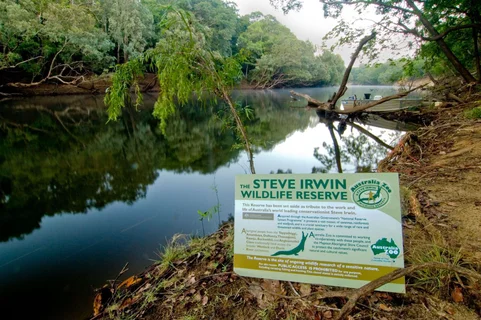


A Wild River of Cape York
The Wenlock River flows north-west from the Great Dividing Range across Cape York Peninsula before reaching the Gulf of Carpentaria. Its catchment includes tropical savannah, wetlands, tributaries and seasonal creeks that support rich biodiversity. The river contains the highest diversity of freshwater fish species in Queensland, including the endangered freshwater sawfish. It also supports one of Queensland’s most significant breeding populations of saltwater crocodiles.
The Threat
After Queensland’s Wild Rivers Act passed through Parliament in 2005, conservation groups began campaigning for important river systems to receive formal protection under the legislation. One major concern was a proposed bauxite mine linked to Cape Alumina near the Wenlock River. The mine threatened areas surrounding what is now known as the Steve Irwin Wildlife Reserve. Campaigners feared mining could damage the river system and surrounding ecosystems if development proceeded.
The Campaign
The campaign brought together an unusually broad alliance. Terri Irwin became a prominent supporter due to the proposed mine’s proximity to the Steve Irwin Wildlife Reserve. The Wilderness Society worked alongside Traditional Owners, local cattle farmers and Terri Irwin to oppose the development and secure Wild River protections for the Wenlock. Public support rapidly grew. More than 280,000 people registered their opposition to the mining proposal. Campaigners argued that development should not compromise the ecological integrity of one of Cape York’s last major free-flowing river systems.
Protection Achieved
In 2010, the Wenlock River was formally declared under Queensland’s Wild Rivers Act. The declaration protected the river system from developments that would damage its environmental values while still allowing lower-impact activities to occur. The declaration also helped stop the proposed bauxite mine from proceeding.
Legacy
The Wenlock River campaign became one of the most prominent Wild Rivers victories in Queensland. It demonstrated the strength of alliances between conservation groups, Traditional Owners, local communities and high-profile public advocates in protecting ecologically significant landscapes. As Glenn Walker later recalled:
“Shortly after we won the campaign, I took a group of volunteers on a trip on the Cape for a couple of weeks. And I remember sitting by myself on the banks of the Wenlock, and a couple of Palm cockatoos came and visited, said hi and were squawking and then flew up the river.”