

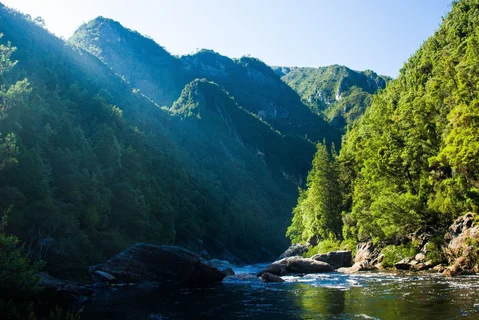


A River—and a Movement
The Franklin River rises in Tasmania’s central highlands before flowing 125 kilometres west through dense rainforest and dramatic wilderness into the Gordon River and Macquarie Harbour. In 1976, just 16 people gathered in the home of Bob Brown to form the Tasmanian Wilderness Society. That same year, Bob Brown and Paul Smith rafted down the Franklin River in rubber dinghies—helping reveal the scale, beauty and significance of the landscape to a wider audience. As dam proposals intensified, so did public opposition. Then in 1981, another extraordinary discovery changed the debate: caves containing evidence of Aboriginal occupation dating back 20,000 years were found in areas that would be flooded by the dam.
The Campaign to Save the Franklin
Led by Bob Brown and thousands of supporters from all walks of life, the campaign rapidly became one of the largest environmental movements Australia had ever seen. People held public meetings, distributed pamphlets, wrote letters, appeared on television, spoke to politicians, and invited Australians to experience the Franklin for themselves. Membership of the Wilderness Society grew rapidly—from around 200 people to almost 2,000 by mid-1980. Momentum continued to build.
“In 1981, a referendum on the dams saw 45% of electors cast an informal vote, with around 32% of all voters writing ‘NO DAMS’ directly on their ballot papers.”
In February 1982, Prime Minister Malcolm Fraser called a federal election. On the same day, Bob Hawke replaced Bill Hayden as Opposition Leader and declared his support for saving the Franklin. Across Australia, support surged. More than 20,000 people rallied in Hobart. Volunteers letterboxed homes, distributed leaflets and campaigned in marginal electorates. On election day, around 13,000 volunteers staffed polling booths in support of the Franklin campaign. One image became iconic: photographer Peter Dombrovskis’s photograph of Rock Island Bend on the Franklin River, published in full-page newspaper advertisements with the words:
“Could you vote for a party that will destroy this?” Hawke narrowly won the election and announced the dam would not proceed. But the Tasmanian Government challenged the decision in the High Court. In July 1983, the High Court ruled in favour of the Federal Government—allowing the Franklin River to remain free-flowing and establishing a landmark precedent for protecting World Heritage areas in Australia. Today, the Franklin River and surrounding wilderness are protected as part of the Tasmanian Wilderness World Heritage Area.
The Blockade
The Franklin campaign also became famous for its direct action blockade. Thousands of people travelled to Tasmania to stand between the river and the bulldozers. Around 6,000 people registered to help. Nearly 1,500 wilderness protectors were arrested during the blockade, and hundreds were taken across the island to Risdon Prison in paddy wagons. The protests captured national attention and helped redefine environmental activism in Australia.
Legacy
The Franklin campaign proved that ordinary people could stop powerful industrial projects—and that direct action, when combined with public support and political pressure, could change the course of history. The High Court decision also confirmed the Federal Government’s power to protect places of World Heritage significance. Those same powers would later help protect places like the Daintree Rainforest. The campaign’s influence continues to this day, inspiring generations of environmental movements and peaceful protests across Australia. Tasmanian Premier Robin Gray once dismissed the Franklin River as:
“Nothing but a brown ditch, leech-ridden, unattractive to the majority of people.” Australians disagreed. As Bob Brown later reflected:
“We decided, while the river remained flowing free to the sea, our campaign would flow and grow with it. And look what happened! […] Whenever I find the prospects daunting, I turn my mind to the dark days of the Franklin campaign and get great pleasure from remembering how we opted for action over despair.”