

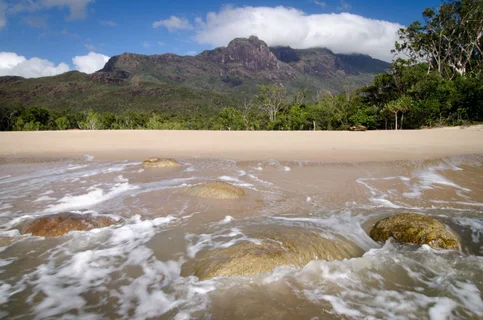


A World Heritage Landscape
Hinchinbrook Island and the channel separating it from the mainland are part of the Great Barrier Reef World Heritage Area. The landscape includes mountains, mangrove systems, seagrass meadows and important coastal habitats. Marine species found in the region include dugongs, green turtles and the threatened Irrawaddy dolphin. Campaigners argued that large-scale development would damage sensitive ecosystems and permanently alter the character of the channel and surrounding coastline.
The Threat
In 1994, the Queensland Government approved the development of a major resort at Hinchinbrook Island. Conservation groups warned that the proposal would destroy mangrove habitat and increase boat traffic through the Hinchinbrook Channel, threatening marine life and ecological systems connected to the Great Barrier Reef. The proposal quickly became a major environmental controversy.
The Campaign
The Wilderness Society campaigned alongside local advocates, scientists and conservation groups to oppose the marina and resort development. Naturalist Margaret Thorsborne became one of the campaign’s leading voices. In November 1994, Federal Environment Minister John Faulkner used the World Heritage Properties Conservation Act to prevent further destructive impacts on the channel. The campaign also gained international attention. In April 1998, a group of internationally recognised scientists and environmental figures—including David Attenborough, David Suzuki, Paul Ehrlich and David Bellamy—signed an open letter calling for Hinchinbrook to be protected. In 1999, the Australian Senate conducted an inquiry into the development and found that environmental assessment processes had been inadequate. Despite the findings, the John Howard Government allowed the development to proceed. The development later became known as Port Hinchinbrook.
Legacy
The Hinchinbrook campaign became one of Australia’s most prominent coastal conservation battles of the 1990s. It highlighted tensions between tourism development and World Heritage protection and drew national and international attention to environmental assessment processes within sensitive coastal ecosystems.