

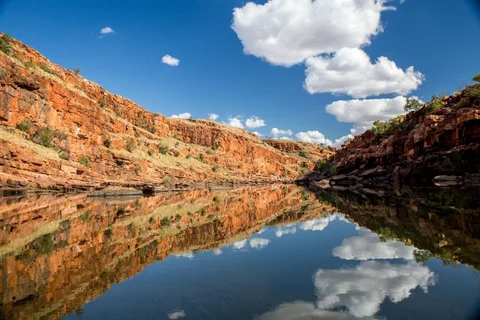


A River With Spirit
When the monsoon arrives in the Kimberley, the land transforms.
Parched savannah erupts into colour. Floodwaters spread across vast plains. Gouldian finches flash through the skies. Ancient boab trees stand watch over one of the last great free-flowing river systems left on Earth.
Martuwarra / Fitzroy River is not simply a river.
For the Traditional Custodians of the Kimberley — including the Nyikina, Bunuba, Gooniyandi, Walmajarri and Wangkatjunka people — Martuwarra is a living ancestral being. A river with spirit. Law. Memory.
It is also one of the last places on Earth where critically endangered freshwater sawfish still survive in the wild.
The Threats
After the defeat of the gas hub at Walmadany / James Price Point, attention turned inland.
The Kimberley’s rivers, aquifers and ancient landscapes were increasingly targeted by mining, irrigation and gas companies seeking to industrialise the region. Coal mining proposals emerged along the banks of Martuwarra. Plans for large-scale irrigation threatened to extract enormous volumes of water from the river system. And the expansion of fracking across the Kimberley loomed as one of the greatest threats of all.
For Traditional Custodians and conservationists alike, the danger was clear: once industrialisation entered the catchment, the ecological and cultural integrity of the river could be permanently damaged.
The Campaign
Since 2010, the Wilderness Society has worked alongside Kimberley communities to oppose gas fracking across the region and defend the Martuwarra catchment.
A defining moment came in 2016, when Anne Poelina challenged a proposed coal mining development at Duchess Paradise near the riverbanks. The campaign was about far more than stopping a single mine — it was about asserting a different vision for the Kimberley, one grounded in ecological protection, cultural responsibility and First Nations leadership.
Out of these growing threats came a powerful new alliance. The Martuwarra Fitzroy River Council was formed to unite Traditional Custodians in defending the river system. With support from the Wilderness Society, the Council established the Martuwarra River Keepers program — a First Nations-led initiative focused on healing Country, protecting cultural knowledge and creating sustainable livelihoods grounded in caring for the river.
Legacy
The campaign for Martuwarra has become part of a larger movement to rethink humanity’s relationship with rivers themselves. Rather than viewing rivers as resources to be extracted, Traditional Custodians have argued that Martuwarra must be recognised as a living system with rights, spirit and intrinsic value.
Today, the fight continues. But the movement to protect Martuwarra has already reshaped national conversations around Indigenous leadership, river protection and the future of Australia’s remaining intact landscapes.
“We are starting something here that is bottom-up and creating a diverse, transformative workforce that is really healing Country and showing that there’s a different way to have sustainable livelihoods, a sustainable life on Country by working with these projects and healing the riparian zone.” — Dr Anne Poelina, Chair of the Martuwarra Fitzroy River Council