

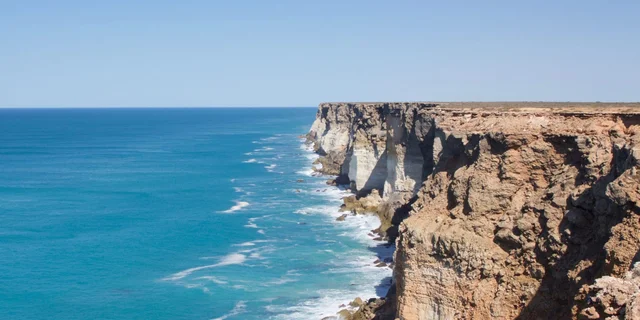


At the meeting place of desert and ocean, the Great Australian Bight remains one of the most extraordinary marine ecosystems on Earth. Along the towering Bunda Cliffs—the longest continuous sea cliffs in the world—the vast limestone plain of the Nullarbor drops abruptly into the Southern Ocean. Here, nutrient-rich waters collide and create one of Australia’s most productive marine environments. Southern right whales return each winter to calve and nurse their young in sheltered waters. Australian sea lions breed on remote islands. Great white sharks patrol offshore reefs. Dolphins, seals, seabirds and countless fish species depend on this spectacular and largely intact ecosystem. For the Yerkala Mirning people, this is far more than a coastline. It is sacred Country where land, sea and sky are inseparable. Whale dreaming stories connect generations of Mirning people to the ocean and to Jeedara, the great ancestral white whale who created this place and remains central to Mirning culture and identity. The caves, cliffs, sea and desert form one continuous cultural landscape cared for over more than 65,000 years. In 2011, global oil giant BP acquired exploration leases and announced plans to drill for oil in the Great Australian Bight. The proposal came shortly after the Deepwater Horizon disaster in the Gulf of Mexico, which demonstrated the catastrophic consequences that offshore oil drilling can have when things go wrong. A major oil spill in the Bight would have devastated marine life, coastal communities, fisheries and tourism industries across southern Australia. The Wilderness Society, together with Mirning Traditional Owners, coastal communities, surfers, fishers, scientists, tourism operators and conservation organisations, launched one of the largest marine conservation campaigns in Australian history. After years of mounting public pressure, BP abandoned its drilling plans in 2016. Chevron withdrew in 2017, followed by Equinor in 2020. It was a remarkable victory. But the fight is far from over. The same geological formations that attracted oil companies remain highly sought after by the fossil fuel industry. Without permanent protection, future governments could once again release these waters for oil and gas exploration. That is why the campaign has evolved from stopping drilling to pursuing a far more ambitious goal: World Heritage protection for the Great Australian Bight and the Nullarbor Plain.
What Is at Risk
The Great Australian Bight is one of the world’s most important whale nurseries and one of Australia’s most biologically significant marine ecosystems. Its waters support endangered southern right whales, Australian sea lions, migratory seabirds, sharks, dolphins and countless other marine species. The adjacent Nullarbor contains globally significant caves, karst systems and a vast living cultural landscape of immense significance to the Yerkala Mirning people. Without permanent protection, this extraordinary region could once again face oil and gas exploration, seismic testing and other industrial threats.
The Campaign
The Wilderness Society is working alongside the Mirning Traditional Owners, scientists, coastal communities and partner organisations to secure World Heritage protection for the Great Australian Bight and Nullarbor. The campaign combines First Nations leadership, scientific research, international advocacy and public mobilisation to build support for one of the most ambitious conservation proposals in Australia’s history. The vision is to create one of the world’s great cultural and natural conservation estates—protecting the cliffs, caves, ocean, wildlife and living stories that define this remarkable place. The goal is simple but profound: to ensure that the Great Australian Bight is protected forever.