

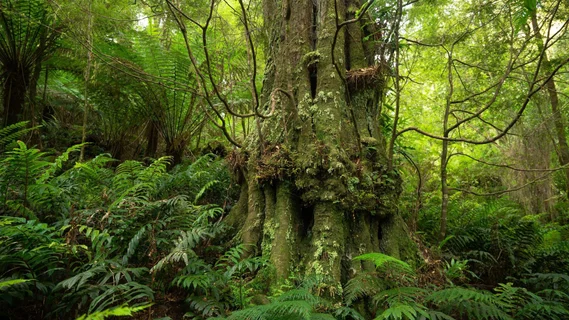


A Forest of Extraordinary Diversity
The Otways contain old-growth forests, cool temperate rainforest, wet forests, heathlands, coastline and important marine environments. The region provides habitat for threatened species including the Otway black snail, spotted tail quoll, southern brown bandicoot and long-nosed potoroo. Threatened forest owls—including the powerful owl, masked owl and sooty owl—also occur throughout the forests, alongside coastal species such as the rufous bristlebird. The region is culturally significant to the Gadubanud people, also known as the “King Parrot” people. Today, the Eastern Maar people and Wadawurrung people are formally recognised as Traditional Owners across the Great Ocean Road region.
The Campaign
In 1994 and 1995, the Paul Keating Government approved woodchipping in hundreds of logging coupes identified as having high conservation value, including forests in the Otways. The decision intensified public opposition to logging. In January 1995, the Wilderness Society led a rally of around 10,000 people in the streets of Melbourne protesting logging in the Otways and other Victorian forests. That same year, the logging industry staged the well-known log-truck blockade of Parliament House in Canberra. Campaigners used a wide range of strategies throughout the campaign. Activists from OREN produced reports, calendars, stickers, articles and public presentations, while guided forest tours introduced people to the Otways landscape firsthand. The campaign also targeted major corporations, lobbying companies manufacturing products such as Amcor and Kimberly Clark over the sourcing of woodchips from native forests.
Direct Action in the Forests
Non-violent direct action became a defining part of the campaign. Protesters padlocked themselves to logging machinery, occupied trees and blockaded roads to slow or stop logging operations. Some campaigners even buried their limbs beneath roads to obstruct access into logging coupes. The campaign drew support from activists including Amelia Young, Luke Chamberlain, Gavan McFadzean, Jaxon Barnes and Simon Birrell. Political change also shifted the campaign landscape. After a Victorian state election in 1999 brought a change of government, campaigners saw new opportunities for forest protection.
Protection Achieved
Following years of sustained advocacy and campaigning, the Victorian Government announced new policies in 2002 to protect the Otways. Then in 2005, legislation established the 102,000-hectare Great Otway National Park and the 40,000-hectare Otway Forest Park. The outcome marked a major conservation victory for the region and significantly reduced clearfell logging across the Otways.
Legacy
The Otways campaign became one of Victoria’s defining forest protection movements. It combined grassroots activism, corporate campaigning, mass rallies and direct action to challenge native forest logging and build public support for large-scale conservation. As one protester told the ABC:
“I’ve been scooped along by a bulldozer, I’ve been chased by somebody with a chainsaw, I’ve had an axe thrown at me.” And as Simon Birrell reflected:
“I took the view that if you couldn’t stop logging in the Otways, you couldn’t stop it anywhere.” Gavan McFadzean said:
“Forrest’s ecotourism economy dwarfs the old logging economy. Where native forest logging only benefited a handful of vested interests, this new formula reaches far and wide.”