

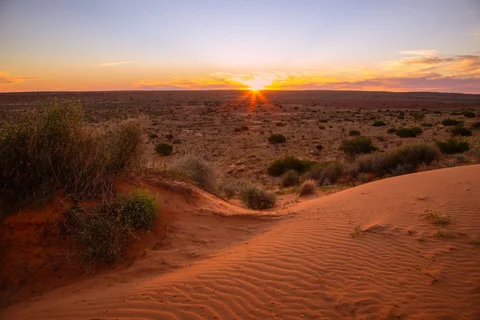


One of the World’s Most Intact Desert Ecosystems
The Munga-Thirri / Simpson Desert sits within the vast Lake Eyre Basin alongside Queensland’s Channel Country and Kati Thanda-Lake Eyre—a globally important wetland and bird habitat. The desert supports more than 900 species of plants and animals, including the water-holding frog, specialised desert reptiles, and rare mammals such as the kowari. Birds uniquely adapted to this environment, including the grey grasswren and Eyrean grasswren, also call the desert home. The region is equally significant culturally. The South Australian section includes the traditional lands of the Wangkangurru/Yarluyandi people, alongside Aranda and Arrente peoples, whose connections to Country stretch back thousands of years. Stories of mikiri—freshwater soaks hidden within claypans, swamps and salt lakes—are deeply interwoven with the landscape and enabled travel and survival across the desert for generations. Rock carvings and culturally significant places occur throughout the region.
The Campaign
The Wilderness Society began campaigning for stronger protection of the Munga-Thirri / Simpson Desert in 2010. That year, an expedition was undertaken to document the wilderness values of the region and assess whether the desert met the criteria for formal protection. In 2011, the Wilderness Advisory Committee—a statutory body—recommended to the South Australian Government that the Simpson Desert region was high-quality wilderness and qualified for protection. Over the following years, the Wilderness Society met with the South Australian Government regarding possible boundaries for a Wilderness Protection Area in the desert. But while discussions continued, fossil fuel exploration licences were granted. In 2013, petroleum exploration licences were issued to Stuart Petroleum. the Wilderness Society engaged with the company to raise concerns about industrial activity in one of the world’s most intact desert ecosystems. Then in 2017, multinational company Tri-Star Energy took over the licences and later announced plans to expand fossil fuel exploration in 2020. Community opposition quickly intensified. The Wilderness Society met with company representatives, government officials and Ministers to argue against oil and gas expansion in the desert and push for long-term protection of the region.
A Major Conservation Victory
In November 2021, the South Australian Government proclaimed Australia’s largest ever national park in the Munga-Thirri / Simpson Desert. It was a landmark conservation outcome after more than a decade of advocacy and campaigning. Then in October 2024, the remaining oil and gas exploration leases in the region were retired. Together, the decisions secured stronger protection for one of Australia’s most ecologically and culturally significant desert landscapes.
Legacy
The protection of the Munga-Thirri / Simpson Desert demonstrated the growing recognition of large-scale landscape conservation in a changing climate. It also reinforced the importance of protecting intact ecosystems before industrial development fragments them. As Peter Owen said:
“This new national park is a grand initiative, on a scale we have been advocating for over a decade. Conservation measures like this are critically important, allowing endangered animals and plants to move and adapt to a rapidly changing climate.”