

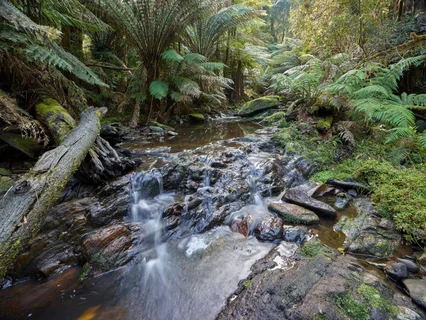


In the far east of Victoria, some of Australia’s tallest and oldest forests still stand. Towering mountain ash forests rise nearly 90 metres into the sky. Ancient rainforest gullies shelter rare wildlife found nowhere else on Earth. Rivers carve through rugged mountain ranges shaped over millions of years. And for decades, these forests were logged at an industrial scale. From the late 1980s onwards, the Wilderness Society became a major force in the fight to protect East Gippsland’s forests—helping drive one of the longest-running forest conservation campaigns in Australian history.
Ancient Forests, Rare Wildlife
The forests of East Gippsland form part of an ancient Gondwanan landscape and sit within a unique climatic zone that supports extraordinary biodiversity. These forests are home to endangered species including the long-footed potoroo, greater glider and yellow-bellied glider, as well as the critically endangered Leadbeater’s possum—a species believed to have first emerged in these forests around 20 million years ago. The region also contains some of Victoria’s most significant rainforest ecosystems. The Traditional Owners of East Gippsland are the Gunaikurnai people, representing the Brataualung, Brayakaulung, Brabralung, Taungurung and Krauatungalung clans, who maintain long and continuing custodianship of the land and waters.
The Fight Against Logging
By the late 1980s, the Wilderness Society’s Victorian branch had become a key player in campaigns to protect Victoria’s native forests from logging. In the 1990s, conflict intensified after the Keating Government approved woodchipping in hundreds of East Gippsland logging coupes identified as having high conservation value. After years of campaigning and building relationships with First Nations communities and local conservation groups, the Wilderness Society helped organise major rallies through Melbourne’s CBD in 1995 to protest continued logging. Then in 1997, Australia’s first Regional Forestry Agreement (RFA) was signed for East Gippsland—locking in industrial logging across the region for the next 20 years and shaping forest politics in Victoria for decades.
A New Strategy
Over time, campaigners realised that protecting the forests would require new initiatives alongside established protest tactics. The Wilderness Society launched the Ethical Paper Initiative, using political advocacy and public pressure to push major businesses—including Bunnings and Officeworks—towards ethically sourced paper and timber products. The campaign also brought together an unusually broad coalition of supporters. The Wilderness Society worked alongside First Nations groups, local organisations including Goongerah Environment Centre (GECO), and high-profile Australians including Jack Thompson, Paul Kelly, and members of the cast of Home and Away.
Fire, Forests and Change
In 2009, the Black Saturday bushfires devastated Victoria, burning more than 72,000 hectares of forest in East Gippsland and contributing to the deaths of 173 people across the state. The fires intensified scrutiny of forest management and logging practices. In 2010, the expansion of Errinundra National Park protected 45,000 hectares of East Gippsland forest. Then in 2015, the Forest Industry Taskforce began—a process in which the Wilderness Society worked with other conservation groups, unions and industry representatives to force recognition of long-term wood supply constraints in Victoria’s native forest industry.
A Major Turning Point
In 2023, the Victorian Government announced the end of industrial native forest logging in the state. The closure was brought forward from 2030 to 1 January 2024, marking one of the biggest conservation victories in Victoria’s history. But campaigners say the work is not over. The Wilderness Society continues advocating for permanent protection through proposals including the Great Forest National Park and the Emerald Link—a community-led vision connecting protected forests and nature-based tourism opportunities across eastern Victoria.
Legacy
The East Gippsland forests campaign reshaped how Australians think about native forests, logging, biodiversity and climate. It also demonstrated how long-term environmental campaigns evolve—through protest, political pressure, partnerships, consumer action and community organising. As Amelia Young said:
“We have an opportunity to secure a sanctuary for these special forests and all the wildlife that call them home. In some ways, the campaign is just beginning.” And as Tom Crook explained:
“This region has the lion’s share of significant rainforest in Victoria. It sits in this bioclimatic window that allows it to have different rainforest types that occur all in the one place, that don’t occur in the one place anywhere else.”