



Forests of Giants
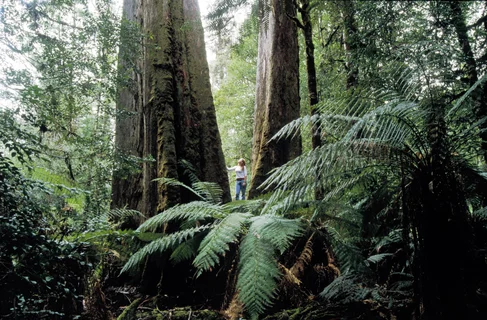
The Styx Valley is one of the great strongholds of Eucalyptus regnans—the tallest hardwood trees and tallest flowering plants on Earth. Some trees in the valley rise more than 90 metres above the forest floor. The Styx River winds through the ancient forests alongside its major tributary, the South Styx River, flowing through rainforest, giant eucalypt stands and remote wilderness landscapes. The forests provide habitat for species including the Tasmanian wedge-tailed eagle, eastern pygmy possum, yellow-tailed black cockatoo, owls and rosellas. The western parts of the Styx catchment also connect to one of the world’s largest temperate wilderness areas.
The Campaign Begins
The campaign to stop logging in the Styx Valley began publicly in December 1999 with one of the movement’s most memorable protest actions. Wilderness Society climbers decorated a 77-metre giant tree with 3,000 fairy lights and a massive illuminated star, creating what campaigners described as the world’s largest Christmas tree. The action drew national attention to logging threats in the valley. Throughout the early 2000s, the Wilderness Society ran twice-weekly public tours into the Styx forests, helping thousands of people experience the giant forests firsthand and building broader public support for protection.
Escalation and International Attention
Public outrage intensified after Forestry Tasmania accidentally burned El Grande—one of the largest known trees in Australia—during a regeneration burn. The destruction became national news and further galvanised opposition to old-growth logging. By 2003 and 2004, the Styx campaign had become an international environmental story. Working alongside Greenpeace, the Wilderness Society established the “Global Rescue Station”—a protest platform and camp suspended 65 metres high within one of the threatened giant trees. For months, activists and visitors from around the world travelled to the Styx Valley to witness the forests and support the campaign. The issue also entered federal politics. Labor leader Mark Latham toured the forests with Bob Brown, while rallies and parades organised by both supporters and opponents of logging turned Tasmania’s forests into a national election issue. Writers, musicians, actors and artists also publicly supported the campaign, including Olivia Newton-John, Richard Flanagan, Jimmy Barnes, John Butler and Peter Cundall.
Protection Achieved
After years of campaigning, negotiations and public pressure, major conservation gains were finally secured. In 2013, much of the Styx Valley was included within the Tasmanian Wilderness World Heritage Area, protecting large sections of the valley from logging.
Legacy
The Styx Valley campaign became one of Australia’s defining old-growth forest movements. It combined creative protest, public engagement, international activism and political pressure while helping transform public understanding of Tasmania’s ancient forests. At the height of the conflict, Resources Minister Paul Lennon famously declared:
“They can hold the Academy Awards in the Styx Valley and we still won’t change our policy.” And as forest campaigner Vica Bayley later reflected:
“You’re stepping over moss-covered logs and around ferns, dwarfed by these mammoth, living towers. These trees are the tallest hardwoods in the world, so far above you is a huge canopy. It’s awe inspiring, it’s humbling and it’s part of an ecosystem that is millennia in the making.”