

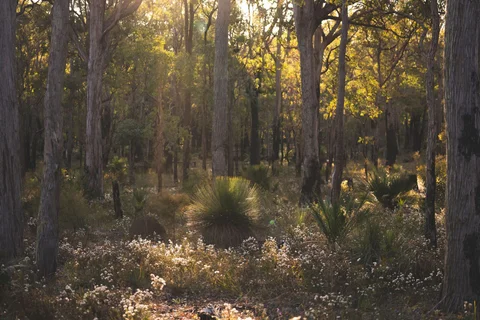


In the south-west of Western Australia, one of the most extraordinary forests on Earth is still under threat.
The Jarrah forests have evolved over tens of millions of years on some of the oldest and most nutrient-poor soils on the planet. In response, life here has become astonishingly diverse and resilient. More than 8,000 species of wildflowers bloom across the landscape. Ancient jarrah and marri trees tower above a rich understory of orchids, banksias and fungi. Three species of endangered black cockatoo—Carnaby’s, Baudin’s and the forest red-tailed black cockatoo—depend on these forests for food and nesting hollows. Quokkas persist in isolated pockets, and countless species of reptiles, mammals, insects and plants occur nowhere else on Earth.
Around 80 per cent of the species found in this global biodiversity hotspot are endemic to the south-west of Western Australia, making the Jarrah forests one of the most biologically significant places on the planet.
For the Noongar peoples, this is living Country—held in story, ceremony and custodianship for more than 45,000 years. The forests are woven into cultural identity and Traditional Ecological Knowledge that continues to guide how Country should be cared for.
For generations, these forests were logged for timber and woodchips. After decades of campaigning by conservationists, scientists, Traditional Owners and communities, the Western Australian Government announced in 2021 that commercial native forest logging would end in January 2024. It was a landmark victory.
But even as the chainsaws fell silent, the greatest threat to the forests remained.
Beneath the canopy lies bauxite—the ore used to make aluminium. Vast open-cut mines operated by companies such as Alcoa and South32 continue to clear ancient forest, fragment habitat, alter water systems and leave behind landscapes that can never truly be restored to their former ecological complexity.
Roads, pits and industrial infrastructure are pushing deeper into the Northern Jarrah Forest, threatening the long-term survival of species already under pressure from climate change, drought and disease.
What Is at Risk
The Northern Jarrah Forest is one of Australia’s most significant biodiversity hotspots and one of its most important natural carbon stores.
Many of the trees being cleared are centuries old and contain nesting hollows that take hundreds of years to form. These hollows provide essential habitat for black cockatoos, possums and a wide array of other wildlife.
The forests also protect drinking water catchments, stabilise local climates and store vast quantities of carbon in living biomass and ancient soils.
Mining threatens to fragment ecosystems, disrupt groundwater, introduce weeds and disease, and permanently alter landscapes that have evolved over millions of years.
No amount of offsets or rehabilitation can recreate an ancient forest within a human lifetime.
The Campaign
The Wilderness Society is working alongside Noongar Traditional Owners, scientists, local communities and partner organisations to stop further industrial clearing and secure lasting protection for the Jarrah forests.
Together, they are commissioning research, mobilising public opposition, organising rallies, lodging legal and regulatory submissions, and exposing the cumulative impacts of mining on this globally significant ecosystem.
The campaign is built around a simple but urgent proposition: If these forests are too precious to log, they are too precious to mine.
The goal is to ensure that the end of logging becomes the beginning of something far greater—the permanent protection of one of the world’s great forests.