

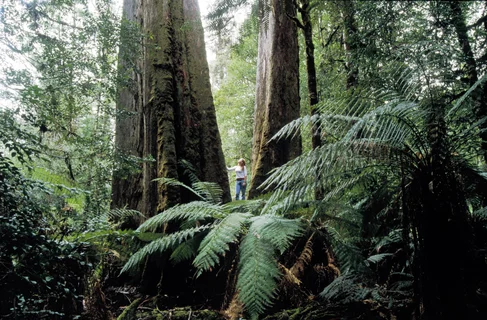


Less than two hours from Melbourne, some of the tallest flowering plants on Earth rise into the sky.
The mountain ash forests of the Central Highlands and East Gippsland are among the most awe-inspiring ecosystems in Australia. Mature trees can exceed 100 metres in height, forming cathedral-like forests of towering trunks, deep fern gullies and moss-covered streams. These extraordinary landscapes store immense amounts of carbon, generate clean drinking water for Melbourne and provide refuge for species found nowhere else on Earth.
Among them is Leadbeater’s Possum—Victoria’s faunal emblem and one of Australia’s most endangered mammals. These forests also support greater gliders, sooty owls, powerful owls, yellow-bellied gliders, giant earthworms and a rich diversity of plants, fungi and invertebrates.
For First Nations peoples, these forests are living cultural landscapes with deep and continuing connections to Country, story and stewardship.
Mountain ash forests are globally significant. They are among the most carbon-dense forests on Earth, storing vast quantities of carbon in their towering trees, fallen logs and rich forest soils. They are also critical climate refuges, helping wildlife survive in a rapidly warming world.
For decades, these forests were logged for paper and timber, fragmenting habitat and reducing the number of large old trees needed by hollow-dependent species.
In 2013, scientists and conservation organisations launched the vision for the Great Forest National Park—a bold proposal to protect these forests as one connected landscape stretching from Kinglake to the Baw Baw Plateau and beyond.
After years of public campaigning, scientific advocacy and community mobilisation, the Victorian Government announced in 2023 that native forest logging would end, and commercial logging officially ceased in January 2024. It was one of the most significant forest conservation victories in the state’s history.
But the work is not yet complete. Ending logging removed the immediate industrial threat, but it did not provide permanent protection. Many forests remain vulnerable to fragmentation, inappropriate management, and the possibility that future governments could weaken or reverse protections.
What Is at Risk
Victoria’s tall forests are globally significant ecosystems and among the most important carbon stores on Earth.
They protect Melbourne’s water catchments, moderate local climates and provide essential habitat for threatened species including Leadbeater’s Possum and the greater glider.
Without permanent legal protection, these forests remain vulnerable to policy reversal, habitat fragmentation, high-intensity fire and management decisions that fail to prioritise ecological recovery.
The loss of large old trees and intact forest connections would have consequences lasting centuries.
The Campaign
The Wilderness Society is working with scientists, Traditional Owners, local communities and conservation partners to secure long-term protection for Victoria’s tall forests.
Central to this effort is the vision for the Great Forest National Park and the Emerald Link—an interconnected reserve system that would permanently protect some of the most carbon-rich and biodiverse forests in Australia.
The campaign combines scientific research, public mobilisation, political advocacy and community storytelling to demonstrate that these forests are worth far more standing than cut down.
The goal is to transform the end of logging into a lasting conservation legacy. To ensure that the giants continue to stand—storing carbon, supplying water, sheltering wildlife and inspiring generations to come.