

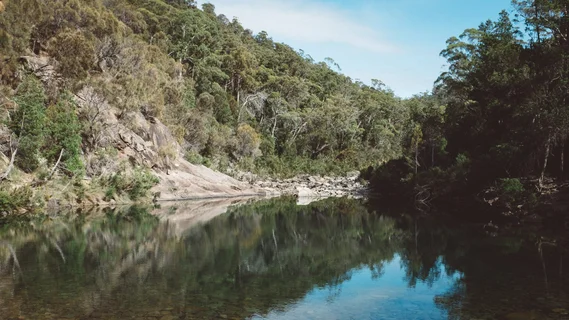


A Rare Dry Forest Landscape
Douglas-Apsley National Park protects an important area of dry eucalypt forest on Tasmania’s east coast. The park contains deep river gorges, wet gullies, marshlands and pockets of rainforest, supporting numerous rare and endangered species including the Swift parrot and masked owl. It is also home to 11 of Tasmania’s 12 endemic bird species and contains 14 species of eucalypts, including the rare Tasmanian ironbark. Five of these eucalypt species are endemic to the area. Douglas-Apsley is the traditional land of the Oyster Bay tribe. The Douglas River is known as leeaberra, a name now used for the walking track that crosses the park. Sites of significant Aboriginal heritage are found throughout the area.
Political Change and the Labor–Greens Accord
The 1989 Tasmanian state election dramatically changed the state’s political landscape. The Labor Government lost its parliamentary majority and five new independent MPs were elected, including Bob Brown. Brown invited the Wilderness Society into negotiations for a new government arrangement, resulting in the Labor–Greens Accord. The Accord delivered major conservation gains, including commitments for new national parks and wilderness protection across Tasmania. One of the proposed outcomes was the creation of a new national park in the dry forests between the Douglas and Apsley rivers.
The Campaign
The proposal to protect Douglas-Apsley became entangled in one of Tasmania’s most notorious political scandals. According to the account provided, the chairman of logging company Gunns offered Labor MP Jim Cox $10,000 to vote against the Labor–Greens Accord. Cox reported the approach to police. Gunns chairman Edmund Rouse was later arrested and imprisoned. Following the scandal, logging industry representatives and conservationists met to negotiate what became known as the Salamanca Agreement. The agreement led to the expansion of the Tasmanian Wilderness World Heritage Area and the declaration of several new national parks, including Douglas-Apsley National Park.
Walking Tracks to Save a Forest
The campaign also relied heavily on grassroots efforts to introduce people to the landscape itself. Conservationist Bob Graham spent three years carving walking tracks through the then-state forest to help people experience the area and understand why it deserved protection. At the same time, he worked to stall proposed logging coupes, while maintaining his family, farm and business. Another important supporter was Arthur Jones, who owned a small farm called Rosedale beside the Apsley River. Jones allowed campaigners access through his property to create walking tracks and promote the national park proposal. After Arthur Jones passed away, his family gifted the Wilderness Society a parcel of land linking the public road to the former state forest, helping continue access to the area.
Ongoing Protection Challenges
In 2013, forests surrounding the national park were included in the Tasmanian Forestry Agreement and protected from logging, although they were not added to the national park boundaries. Then in 2018, Tasmanian Premier Will Hodgman sought to reverse those protections and allow logging to recommence in the interests of the logging industry.
Legacy
The Douglas-Apsley campaign showed how political negotiations, public advocacy and grassroots community action could combine to secure lasting conservation outcomes. It also demonstrated the importance of helping people experience wilderness firsthand as part of building support for protection. As Bob Graham later reflected:
“It wasn’t my first wish to popularise it, but I knew I had to get this place known in order to save it. And that’s why I put a 30-kilometre walking track through this area of State Forest and published route guides, and had functions, and took people for walks, and popularised it.”