

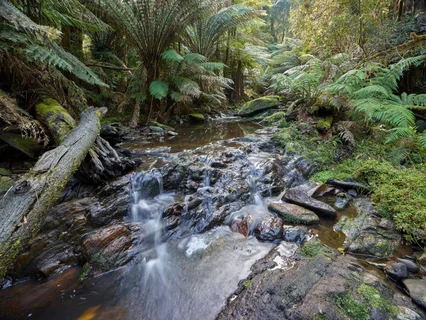


Running the length of eastern Australia, from the rainforests of Far North Queensland to the towering mountain ash forests of Victoria, lies one of the most important ecological systems on Earth.
The Great Dividing Range and its coastal hinterlands form a vast, interconnected chain of forests, escarpments, rivers and wetlands stretching more than 3,500 kilometres. These landscapes capture and store water, regulate climate, hold immense stores of carbon and provide refuge for thousands of species.
This is the green spine of the continent.
Within this living corridor are some of Australia’s most iconic and biologically rich ecosystems: the Wet Tropics, the Gondwana Rainforests, the forests of the Border Ranges, the Pilliga, the Blue Mountains, the Great Dividing Range, East Gippsland and Victoria’s tall forests.
Koalas shelter in eucalypt canopies. Greater gliders leap between ancient trees. Spotted-tailed quolls move through dense undergrowth. Regent honeyeaters, glossy black-cockatoos, powerful owls and countless other species depend on these forests for survival.
For First Nations peoples, these forests are living cultural landscapes, cared for over tens of thousands of years. They hold songlines, sacred places and deep ecological knowledge that continues to guide the stewardship of Country.
Taken together, these forests represent one of the largest remaining temperate and subtropical forest systems in the Southern Hemisphere. They are also one of Australia’s greatest natural climate defences. These forests draw carbon from the atmosphere, cool the land, generate rainfall and protect the catchments that supply water to millions of people. As the climate and extinction crisis accelerates, they provide the connected refuges wildlife needs to move, adapt and survive.
Yet this green spine is being steadily broken apart. Across Queensland, New South Wales and Victoria, native forest logging, land clearing, coal and gas development, mining, urban expansion and weak environmental laws continue to fragment habitats and push species closer to extinction.
Queensland remains a national hotspot for deforestation. In New South Wales, forests such as the Pilliga face the threat of gas extraction. In Victoria, the fight continues to secure permanent protection for the world’s tallest flowering forests.
What is at stake is not just a collection of separate forests. It is the integrity of an entire continental life-support system.
What Is at Risk
The forests of eastern Australia are home to some of the country’s most threatened wildlife and contain immense natural carbon stores.
They protect drinking water catchments, moderate temperatures and sustain the ecological processes that underpin life across the continent.
When forests are cleared or fragmented, wildlife loses habitat and movement corridors, rivers and catchments are degraded, and centuries of stored carbon are released into the atmosphere.
Species that survived for millions of years can be pushed rapidly towards extinction.
Without stronger protections, one of Australia’s most important natural systems will continue to unravel.
The Campaign
The Wilderness Society is working to protect the eastern forests as one connected living system—from Cape York to Victoria.
Across Queensland, New South Wales and Victoria, we are partnering with Traditional Owners, scientists, local communities and conservation allies to keep trees standing, stop destructive fossil fuel projects and secure permanent protection for forests and wildlife corridors.
This includes defending the Pilliga from gas development, ending broadscale land clearing in Queensland, supporting the Great Koala National Park, and securing lasting protection for Victoria’s tall forests.
The vision is bold and necessary: to rebuild and protect one of the largest climate adaptation corridors on Earth. A connected chain of forests capable of storing carbon, generating rainfall, sheltering wildlife and sustaining life for generations to come.
The green spine of the east is still standing. And with enough support, it can remain whole.