

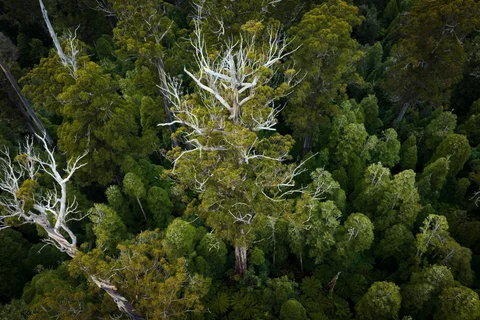


In Lutruwita / Tasmania, some of the oldest and most carbon-dense forests on Earth are still standing.
Towering mountain ash rise above fern-filled gullies. Ancient Huon pines and myrtles trace their lineage back to Gondwana. Moss-covered logs nurse new life on the forest floor. Rivers run tannin-dark through valleys where ecological processes continue much as they have for millennia.
These forests are among the most ecologically significant temperate forests in the world. They store vast amounts of carbon, regulate water systems and provide critical refuge for species found nowhere else, including the critically endangered swift parrot, the Tasmanian wedge-tailed eagle, the giant freshwater crayfish, masked owls and the Tasmanian devil.
For palawa people, these forests are part of a living cultural landscape shaped by deep connection, knowledge and care extending back more than 40,000 years.
For more than half a century, the Wilderness Society has been at the centre of campaigns to protect Tasmania’s forests—from the Franklin to the Styx, the Weld, the Upper Florentine and takayna / Tarkine.
These campaigns have delivered some of the greatest conservation victories in Australian history, including the protection of vast tracts of old-growth forest and the 2013 expansion of the Tasmanian Wilderness World Heritage Area.
Yet despite these achievements, native forest logging continues in parts of Tasmania. Ancient forests are still being clearfelled, chipped and burned. Habitat critical to endangered species is being fragmented, and ecosystems that have evolved over centuries are being reduced to short-rotation plantations and wood products.
At a time of accelerating climate change and biodiversity loss, these forests are more valuable than ever.
What Is at Risk
Tasmania’s native forests are among the most important natural carbon stores in the Southern Hemisphere.
Many contain giant trees, centuries-old hollows and complex ecological relationships that cannot be recreated within a human lifetime.
These forests are essential breeding habitat for species on the brink of extinction, including the swift parrot and Tasmanian wedge-tailed eagle.
Continued logging fragments habitat, releases large volumes of stored carbon and undermines one of Australia’s greatest natural climate solutions.
Once ancient forests are lost, their ecological complexity and cultural significance cannot simply be replanted.
The Campaign
The Wilderness Society is campaigning to end native forest destruction and secure permanent protection for Tasmania’s ancient forests.
Working alongside palawa people, scientists, local communities and supporters across Australia, the campaign combines legal action, scientific research, public advocacy and corporate pressure to expose the true cost of native forest logging.
This work is closely connected to efforts to protect the swift parrot, expand World Heritage areas and build a future where forests are valued for the life they sustain rather than the timber they produce.
The goal is clear: to ensure that Tasmania’s ancient forests remain standing—storing carbon, sheltering wildlife and inspiring future generations.