

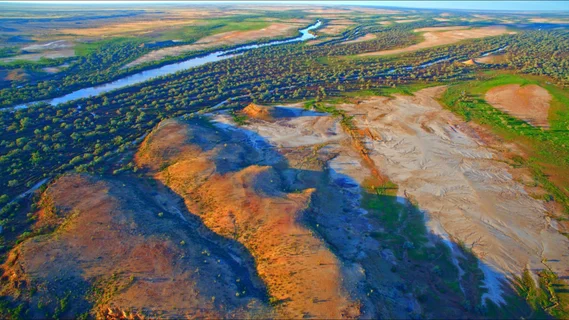


Across the heart of Australia lies one of the world’s last great free-flowing desert river systems.
The Lake Eyre Basin—known to Arabana people as Kati Thanda and to many Traditional Owners across the region as a living cultural landscape—is a vast network of rivers, floodplains, wetlands and arid ecosystems stretching across Queensland, South Australia and the Northern Territory. Covering more than one million square kilometres, it is one of the largest internally draining river systems on Earth.
For much of the time, these rivers appear quiet. But when monsoonal rains fall hundreds of kilometres away, the landscape is transformed. The Cooper Creek, Diamantina and Georgina Rivers spread across immense floodplains, filling waterholes, wetlands and channels that have sustained life for millennia. Millions of waterbirds arrive from across Australia and beyond. Native fish breed in extraordinary numbers. Desert plants burst into life, and one of the driest regions on Earth becomes a vast inland oasis.
This boom-and-bust cycle is one of the great natural spectacles of the planet.
The Basin supports globally significant biodiversity, including threatened species such as the freckled duck, night parrot, grey falcon, Cooper Creek catfish and critically endangered freshwater fish dependent on artesian springs and permanent waterholes.
For countless generations, this has been Country for many Aboriginal peoples, including the Arabana, Wangkangurru, Yandruwandha, Yawarrawarrka and Mithaka peoples. The rivers, floodplains and waterholes are central to cultural identity, story and survival.
Yet this extraordinary system faces a new industrial threat. Beneath parts of the Basin lie substantial oil and gas reserves. For years, fossil fuel companies have sought to expand drilling and fracking across some of the most ecologically sensitive floodplains in Australia.
Industrial development on these floodplains risks polluting groundwater, fragmenting habitat, altering hydrological processes and undermining the natural rhythms that sustain life across the inland.
What Is at Risk
The Lake Eyre Basin is one of the last great unregulated desert river systems on Earth.
Its rivers and floodplains sustain globally significant bird migrations, endangered species and ecological processes that depend on natural flooding.
Oil and gas development, including fracking, could pollute groundwater, disrupt floodplain ecosystems and industrialise one of the most intact inland landscapes left on the planet.
Once damaged, the complex relationships between water, wildlife and culture may be impossible to restore.
The Campaign
The Wilderness Society is working with Traditional Owners, graziers, scientists and conservation allies to protect the Lake Eyre Basin from oil and gas expansion.
Through public mobilisation, scientific advocacy, policy reform and alliance-building, the campaign helped secure landmark protections for Queensland’s Channel Country floodplains.
But the vision extends further. The goal is to ensure that the entire Lake Eyre Basin remains free-flowing, connected and protected from industrial development.
So that when the rains return, the desert can continue to come alive—just as it has for countless generations.