

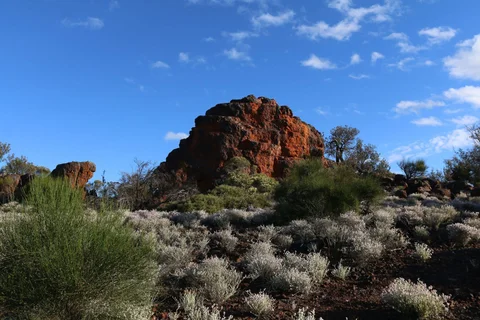


One of the World’s Last Intact Woodlands
The Great Western Woodlands contain some of the most intact woodland ecosystems remaining anywhere in the world. While similar woodlands across Europe, Africa and the Americas have been heavily cleared or fragmented, much of this vast landscape remains relatively undisturbed. The region supports more than 3,300 flowering plant species and around 300 species of eucalypts—including salmon gum, gimlet and morrel—making it Australia’s eucalypt heartland. The landscape stretches across red earth plains, granite outcrops, salt lakes and ancient woodland systems that have evolved over hundreds of millions of years. The Woodlands also hold globally significant carbon stores within their soils, biomass and woody debris.
The Threat
For many years, the Great Western Woodlands received little public recognition or formal protection despite increasing pressures from mining and industrial development. Campaigners feared the fragmentation of one of the world’s last large intact woodland ecosystems. Mining proposals, particularly in ecologically sensitive ranges and woodland systems, became a growing concern.
The Campaign
In 2002, the Wilderness Society began investing in research and public awareness through its Wild Country program. Over several years, the organisation funded scientific work and educational materials highlighting the ecological importance of the region. In 2003, support was established for the Gondwana Link, a major conservation and restoration initiative connecting habitats across southern Western Australia. By 2008, the Wilderness Society formally proposed that the entire Great Western Woodlands region be protected and co-managed to maintain ecological processes across the landscape. In 2010, the Western Australian Government released its “Biodiversity and Cultural Conservation Strategy for the Great Western Woodlands”, although campaigners argued stronger protections and funding were still needed. In 2014, the Ngadju people secured Exclusive Native Title over 4.4 million hectares of Country. The Wilderness Society and Gondwana Link subsequently worked closely with the Ngadju Conservation Aboriginal Corporation to support conservation management across the region. In 2017, the Western Australian Government rejected a proposed iron ore mine at the Bungalbin / Helena and Aurora Ranges, a decision that brought greater public attention and momentum to the broader campaign.
Growing Protection
In 2019, the Western Australian Government committed funding toward creation of a national park within the Great Western Woodlands. Additional park expansions followed in 2020. The campaign also helped drive increased ecological research and volunteer conservation programs throughout the region, including large-scale bird surveys led through BirdLife Australia.
Legacy
The Great Western Woodlands campaign transformed public understanding of one of Australia’s least known but most significant ecosystems. It also strengthened partnerships between conservation organisations, Traditional Owners and local communities working toward long-term ecological protection and healthy Country management.
“The ‘jewel’ of the Great Western Woodlands, Bungalbin never fails to mesmerise. The curved and twisted rock formations—known by some as ‘tortuosity’—create an unmistakable presence when viewed from a distance.”—Patrick Gardner, Wilderness Journal, Issue 013