

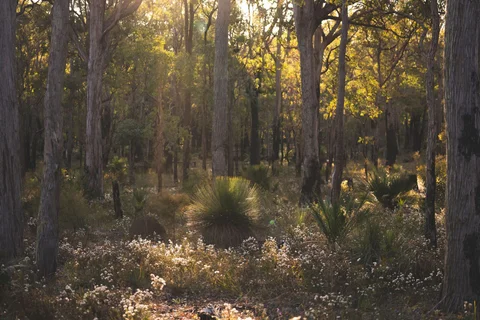


A Forest Found Nowhere Else
The Jarrah forests lie across Noongar people Country in south-west Western Australia. The forests contain towering karri trees—Eucalyptus diversicolor—which can grow more than 90 metres tall and live for around 1,000 years. The region supports extraordinary biodiversity. Wildflowers bloom across the forest floor after rain, black cockatoos nest in ancient tree hollows, and orchids grow throughout the understorey. More than 80% of species found in the region are endemic, meaning they occur nowhere else on Earth. Jarrah timber was historically prized for its resistance to termites and decay and was widely used in ships, railway sleepers and construction.
Rising Conflict
Logging in the Jarrah forests dates back to 1836, but controversy intensified with the expansion of the woodchip industry in the early 1970s. In 1992, the Western Australian Government released a plan proposing a dramatic increase in logging across the forests. The proposal triggered widespread public opposition and the Wilderness Society Western Australia became heavily involved in the growing campaign.
The Campaign
In 1998, the Western Australian Government signed a Regional Forest Agreement (RFA) that locked in continued logging while providing only limited protections for forests. Community anger intensified. Alongside the Wilderness Society, the WA Forest Alliance and many local community groups campaigned continuously against logging expansion. Public support for forest protection grew rapidly. In 2001, the political party Liberals for Forests emerged as a significant political force during the state election, threatening the seat of the Premier. Following the election, approximately 300,000 hectares of forest were protected through the creation of 30 new national parks. The campaign also attracted support from across the community. Rachel Cleland publicly backed the campaign, while celebrities, fashion designers and AFL coaches addressed large street marches. The campaign’s broad community reach also contributed to the creation of new advocacy groups including Doctors for Forests. Writer Tim Winton described campaigners as ranging:
“from the pierced to the pin-striped, from the blow-waved to the dreadlocked”.
Native Title and the End of Commercial Logging
In 2021, settlement commenced for the Noongar Native Title agreement—the largest Native Title settlement in Australian history. The settlement involved six Indigenous Land Use Agreements across south-west Western Australia, covering much of Jarrah Country. Then in 2024, the Western Australian Government announced a complete end to commercial logging in the Jarrah forests, alongside an 11-year transition plan. The campaign secured protections across at least 700,000 hectares of forest.
Legacy
The Jarrah forests campaign became one of the most significant environmental movements in Western Australia. It challenged long-standing assumptions about forests, logging and political power, and demonstrated the influence of broad community mobilisation across environmental campaigns. As Daniel Garlett said in Wilderness Journal:
“As a human being and a good humanitarian, in the efforts of saving the environment, you need to ask yourself, ‘Do we really need all this?’ If we all want the same thing, none of it will be left. And you can’t regrow the jarrah forests.”