

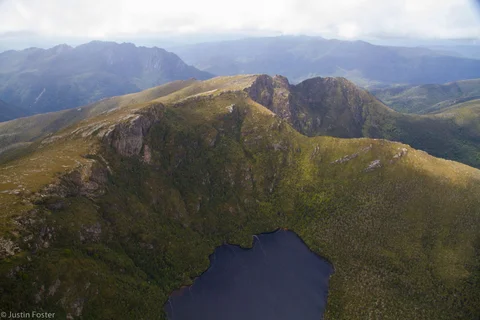


In the far south of Australia lies one of the greatest temperate wilderness areas on Earth. Lutruwita / Tasmania is a landscape of ancient rainforests, wild rivers, glaciated mountains, button grass plains and remote coastlines where ecological processes continue much as they have for millennia. Here, Huon pines live for thousands of years. Alpine moorlands stretch across windswept plateaus. Rivers run clear through deep valleys. Vast forests store extraordinary amounts of carbon and provide refuge for species found nowhere else on Earth. This is also palawa Country. For Tasmanian Aboriginal people, these landscapes hold a profound and enduring cultural connection extending back more than 40,000 years. Rock shelters, shell middens, artefacts and cultural sites reveal one of the oldest continuing human relationships with a temperate wilderness anywhere in the world. In 1982, after years of advocacy, the Tasmanian Wilderness was first inscribed on the UNESCO World Heritage List. It was recognised as one of the few places on Earth to meet all four natural World Heritage criteria. Over the following decades, the Wilderness Society led campaigns to expand protection, resulting in major additions in 1989, 2013 and subsequent years. These victories secured globally significant areas including the Styx, Weld and Upper Florentine valleys, some of the tallest flowering forests in the world, and vast tracts of alpine and temperate wilderness. Yet the story is unfinished. Many areas with outstanding World Heritage values remain outside the protected boundary. Some continue to face logging, mining, inappropriate tourism development and political pressure to weaken protections. The wilderness that qualifies for World Heritage status is still waiting to be fully recognised and permanently protected.
What Is at Risk
Lutruwita / Tasmania contains some of the world’s most carbon-dense forests, ancient Gondwanan ecosystems and extraordinary Aboriginal cultural landscapes. Areas outside the World Heritage boundary remain vulnerable to logging, mining, private developments and other activities incompatible with true wilderness protection. Even within the existing World Heritage Area, decisions about tourism infrastructure and management can set precedents that undermine the principle that some places should remain genuinely wild. Without stronger protections, globally significant landscapes and cultural heritage values could be incrementally degraded.
The Campaign
The Wilderness Society is campaigning to expand and strengthen the Tasmanian Wilderness World Heritage Area and ensure that all areas of outstanding universal value receive the protection they deserve. Working alongside palawa people, scientists, community supporters and international conservation allies, the campaign combines scientific research, public advocacy, legal action and international engagement with UNESCO processes. The vision is to complete one of the world’s great conservation achievements by ensuring that all of Tasmania’s World Heritage-worthy wilderness is recognised, respected and protected for generations to come.